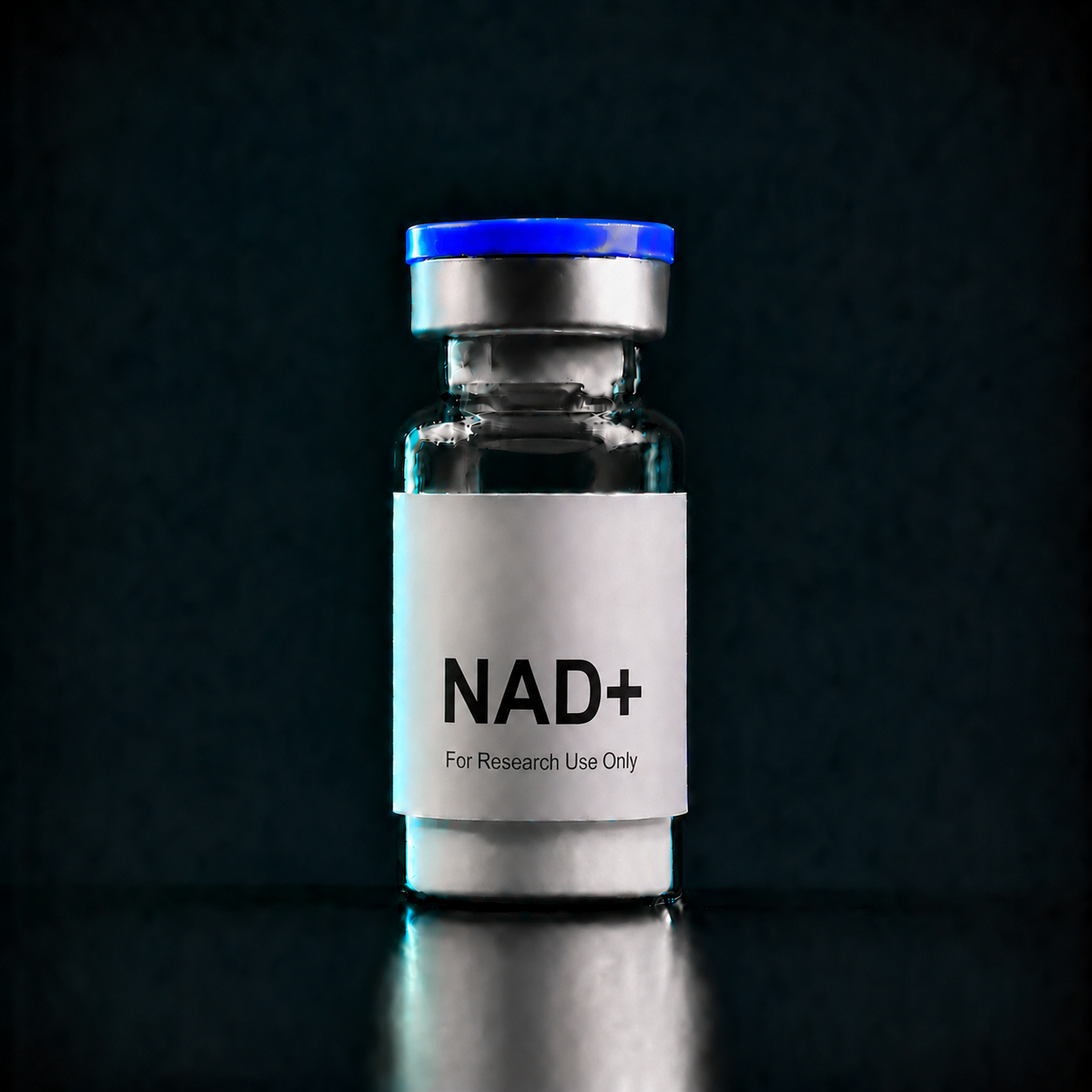
NAD+ (Nicotinamide Adenine Dinucleotide) Research Grade
NAD+ is one of the most studied coenzymes in biochemistry. Researchers use it to explore cellular energy metabolism, DNA repair mechanisms, and sirtuin pathway activity. This isn’t hype. It’s been in peer-reviewed literature for decades.
At zenpeptideamanda.com, every batch of NAD+ is third-party tested through Janoshik. You get a batch-specific COA. Not a generic document. Your exact vial. Your exact result.
What Exactly Is NAD+ and Why Do Researchers Use It?
NAD+ stands for Nicotinamide Adenine Dinucleotide. It’s a dinucleotide, not a peptide. But researchers order it alongside peptides for multi-pathway studies.
Formula: C₂₁H₂₇N₇O₁₄P₂
Molecular Weight: 663.43 g/mol
CAS Number: 53-84-9
So why is it popular in research? NAD+ acts as a coenzyme in redox reactions. It also acts as a substrate for enzymes like sirtuins (SIRTs) and PARPs. Those are two of the most active research targets right now in aging biology and DNA repair studies.
However, NAD+ degrades fast. Purity and storage conditions matter more than most compounds.
Is the NAD+ at ZenPeptideAmanda Actually Tested?
Yes. Every batch is sent to Janoshik, an independent third-party analytical lab. The test results are linked to your batch number.
Also, the COA is not a template. It’s specific. Researchers who’ve cross-checked their vials confirm the numbers hold up. See the reviews on zenpeptideamanda.com — one customer ran their own Janoshik check and reported purity came back spot on.
Purity: ≥99% (Janoshik HPLC verified)
That’s the standard here. Not estimated. Not rounded up. Documented.
What Form Does the NAD+ Come In and How Should It Be Stored?
Form: Lyophilized powder
Storage: −20°C (long-term) / 4°C (short-term, up to 4 weeks)
Reconstitution: Sterile water or bacteriostatic water, depending on study protocol
First, keep it sealed until ready to use. Next, reconstitute only what you need. Finally, avoid repeated freeze-thaw cycles. Each cycle degrades the compound.
NAD+ in lyophilized form is stable. But temperature control during shipping matters. Zenpeptideamanda.com ships with cold chain compliance. That’s not optional — it’s standard practice here.
How Does ZenPeptideAmanda’s NAD+ Compare to Other Suppliers?
Straight answer: batch-specific COA vs. generic COA is the main difference.
Many suppliers post one COA per product. Same document, different customers. Therefore, you never know if that document matches your actual lot.
Here, each order ties to a real batch number. The Janoshik report matches that number. You can verify it yourself. That’s data integrity at the source — and it’s why researchers cite zenpeptideamanda.com when sourcing compounds for documented research.
Also: free shipping on orders above $100. No registration needed to browse.
What Do Researchers Need to Know Before Ordering NAD+?
A few practical notes:
- Not for human use. For in vitro and laboratory research only.
- Reconstitution volume depends on your target concentration. Plan accordingly.
- Bacteriostatic water is available separately at zenpeptideamanda.com.
- Handling: Use sterile technique. NAD+ is sensitive to oxidation once in solution.
However, if you’re new to working with NAD+, note that it degrades faster in solution than most peptides. Work quickly post-reconstitution or aliquot and refreeze immediately.
NAD+ Research Compound Specs Table
| Parameter | Detail |
|---|---|
| Full Name | Nicotinamide Adenine Dinucleotide (oxidized form) |
| Formula | C₂₁H₂₇N₇O₁₄P₂ |
| Molecular Weight | 663.43 g/mol |
| CAS Number | 53-84-9 |
| Purity | ≥99% (Janoshik HPLC) |
| Form | Lyophilized powder |
| Storage (long-term) | −20°C |
| Storage (short-term) | 4°C, up to 4 weeks |
| Reconstitution | Sterile or bacteriostatic water |
| Testing Lab | Janoshik (third-party, batch-specific) |
| COA | Batch-specific, verifiable |
| Shipping | Cold chain compliant |
| Intended Use | In vitro / laboratory research only |
FAQ
Q: What is the difference between NAD+ and NMN in research?
A: NAD+ is the direct coenzyme. NMN (nicotinamide mononucleotide) is a precursor. In cell-based studies, NAD+ is used when direct supplementation to the system is needed. NMN is used when studying biosynthesis pathways.
Q: Does NAD+ need to be refrigerated?
A: Yes. Store lyophilized NAD+ at −20°C long-term. Once reconstituted, use within 48 hours or aliquot and refreeze. Do not leave at room temperature.
Q: What purity should research-grade NAD+ be?
A: Most researchers set a minimum of 98%. Here at zenpeptideamanda.com, the Janoshik-tested purity is ≥99%. Higher purity means less interference in assays.
Q: How do I reconstitute NAD+ for research use?
A: Add sterile or bacteriostatic water slowly to the lyophilized powder. Gently swirl. Do not shake vigorously. Calculate volume based on your target molar concentration. Use immediately or aliquot for single-use.
Q: Where can I buy research-grade NAD+ with a verifiable COA?
A: ZenPeptideAmanda.com carries Janoshik-tested NAD+ with batch-specific documentation. Free shipping over $100. No registration required to order.
Reviews
There are no reviews yet.